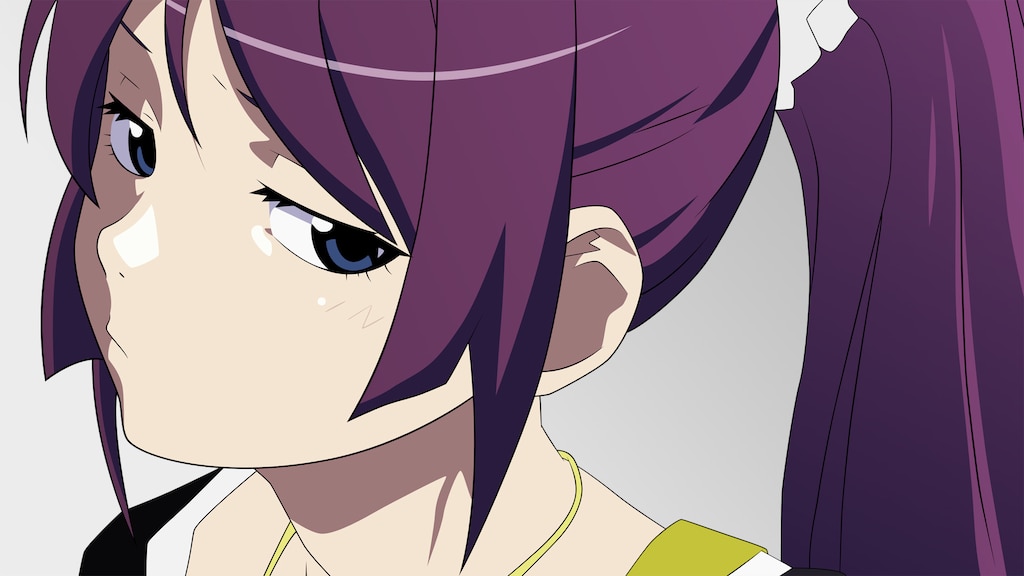
This is one of the pieces I'm most pleased with — please give it a read.

Senjougahara Hitagi is also, to my mind, one of the most captivating female characters in the entire history of the light novel and of TV anime.

Taking the dialogue from S1E2 and S1E3 of the anime as its examples, and weaving in my own reading, this piece digs deep into author Nisio Isin's extraordinary command of the pen — into how he forges the rapier wit of these exchanges — and into the immensely captivating Senjougahara who emerges from it: in her first extended run of dialogue in the series, she delivers a performance that is fiercely aggressive yet brimming with girlish spirit!

Recently, through a mix of language study and simple time-killing, I picked the Monogatari light novels back up in their Taiwanese-edition translations, and at the same time gave the first season of the anime a proper shot-by-shot viewing. So I've effectively been appraising the same text along two axes and from four angles at once: Chinese and Japanese, prose and image. And in the process I couldn't help marveling — slapping my thigh and clicking my tongue in wonder, frankly — at the astonishingly high literary quality hidden beneath the not-terribly-serious genre label of "light novel." In what follows I'll use two scenes from S1E2 and S1E3 of the anime as examples — the conversation in which the protagonist, Araragi Koyomi, escorts one of the heroines, Senjougahara Hitagi, home to bathe and prepare for the purification ritual; and the conversation in Namishiro Park where, after running into Araragi, Senjougahara probes to gauge how he feels about her — to offer a modest analysis of the work's remarkable literary quality, and of author Nisio Isin's almost perverse powers of insight into, and expression of, language, humor, and the psychology of the opposite sex.

S1E2: Araragi Accompanies Senjougahara Home to Bathe

First, the scene in S1E2 where Araragi accompanies Senjougahara home to bathe, beginning at 03:55 of the episode.

Readers with time to spare are encouraged to find this episode and watch the seven-plus-minute clip first — it'll make for a richer experience.

Some background: at school, Araragi accidentally discovers that his classmate Senjougahara has no weight. After she threatens him to mind his own business, he nonetheless offers that a specialist he knows — Oshino Meme — might have a solution. After meeting Oshino, Senjougahara is told to go home, wash her body clean with cold water, and come back in clean, plain clothes for the prayer ritual. In the spirit of seeing a good deed through to the end, Araragi ferries her home on his bicycle to get ready. (Araragi Koyomi — araragi; Senjougahara Hitagi — 戦)

araragi (waiting for her to finish, mulling over his earlier exchange with Oshino): Mmh… a hundred thousand yen, huh.

戦: I'm done with my shower.

戦: Move out of the way, would you. I can't get my clothes out.

araragi: Put some clothes on! Clothes!

戦: I'm about to, obviously.

araragi: I mean you should've had them on to begin with!

戦: I forgot to bring them in with me.

araragi: Then at least cover up with a towel or something!

戦: I'm not doing anything that cheap.

This clip — Senjougahara, fresh out of the bath, blithely getting dressed right in front of Araragi — might strike a first-time viewer as nothing more than a contrived bit of fanservice. But in ordinary life, a young woman would almost never display her body so unguardedly in front of a man outside an intimate relationship. Yet given what's been alluded to earlier — that Senjougahara was deceived by five people and has suffered sexual violation — stripping completely naked in front of Araragi here is in fact, even by real-world logic, her best available strategy. Here's why:

  1. Senjougahara can't yet be sure whether Araragi (and Oshino) genuinely mean to help her, or whether they have some other, less savory aim — sexual, especially. So showing Araragi her naked body right now means that, if he really does harbor bad intentions, he might be provoked into acting on impulse, on the spot.
  2. And by setting this test in her own home, with no second adult male (Oshino) present, she maximizes the odds that even if Araragi did act on impulse, she could fight back — especially in light of the earlier description of her skill at wielding stationery as a weapon.

From this alone you can see how the author's plotting is at once ingeniously clever and acutely perceptive about human nature: even in a tale of the extraordinary set squarely within the everyday, he manages a development that is both perfectly in character and perfectly consistent with common sense.

araragi: That's the first time I've seen a woman completely naked.

戦: Clean clothes, was it.

戦: Do you think white would be better?

araragi: How should I know.

戦: Although, for underwear and bras, I only own ones with patterns.

araragi: How should I know! (even more flustered)

Here, I'd argue, having gotten something out of her first probe, Senjougahara goes a step further and uses conversation to gauge exactly how flustered Araragi currently is. And by common sense, talking to someone while they're rattled is the surest way to saturate their mental bandwidth, leaving them no spare attention — and more likely to let something slip about what they're really thinking. So you can see that Senjougahara's actions and words map extremely, extremely closely onto her character: highly guarded, intelligent, afraid of both Oshino and Araragi, yet genuinely clinging to a sliver of hope that these two might solve her problem.

戦: Araragi-kun — you didn't, by any chance, get turned on looking at my nude body, did you?

araragi: Even if I did, that's not my fault!

戦: All right, you can turn around now.

araragi: Yeah? Sheesh…

araragi: What exactly are you trying to do?!

戦: What's the problem? I'm giving you this much fanservice as today's thank-you.

戦: Show a little appreciation.

戦: Show a little appreciation! (now visibly annoyed)

araragi (narration): She turned it around and got mad at me.

戦: The polite thing would be to offer some kind of comment, no?

araragi: A… a comment, like what?

araragi: Like… "nice body," or something?

戦: Pathetic. That right there is why you'll be a virgin your whole life.

araragi: My whole life?! Are you from the future?!

戦: Could you not spray spit everywhere? Virginity is catching.

araragi: How would virginity be catching to a woman?!

araragi: Hold on a second — this whole conversation is proceeding on the premise that I'm a virgin!

戦: Mm, true. That was prejudiced of me.

araragi: Haah… glad you understand.

戦: Don't spray spit. Amateur-virginity is catching.

araragi: Fine, I admit it — I'm a virgin!

From here on, you can glimpse Nisio Isin's extraordinary command of language. This kind of sexually charged repartee between a man and a woman owes plenty to Japanese manzai comedy, yet it never feels detached from reality — on the contrary, it's the sort of exchange you could say out loud in everyday life without the slightest awkwardness, sharp and full of edge.

  1. Take Senjougahara needling Araragi about being a virgin "his whole life." In a Chinese context we don't often razz someone about being a lifelong virgin, but we are very fond of saying "single for life" (一辈子单身). And here Nisio does something at once unexpected and pinpoint-accurate with that phrase "your whole life," dramatizing it so that Araragi can shoot back, "Are you from the future?!" — a genuinely witty riposte.
  2. Then, when Araragi gets worked up and sprays spit, Senjougahara bluntly calls out the act and dramatizes it along the chain "spitting → spreading disease → virginity is a contagious disease." It's a wonderfully sly point of entry: in daily life, spraying spit while you talk is one of those things that's a little awkward whether you point it out or not — but if you can fold it into the running joke like this, it's both clever and, somehow, a considerate way to tease.

Many people on the forum often ask how to get along with women calmly and naturally — and I think this passage offers an excellent template, something we can genuinely study and put to use in everyday life. In dealing with people (the opposite sex especially), the most important thing to project is a sense of unforced ease — that you aren't thrown into nervous awkwardness merely because the other person is of the opposite sex. And if, on top of that, you can crack a joke that shows off your powers of observation and thought, I'd call that a serious plus. You can even, while joking, land a well-judged, appropriately dosed bit of innuendo — and from that you'll quickly read the other person's attitude on the subject, how receptive they are to you, and whether they came to the meeting carrying the kind of intentions you were hoping for. (That said, I don't think this works identically on everyone; my personal view is that the more educated a woman is, the higher her tolerance for and comprehension of jokes — innuendo-adjacent ones in particular.)

戦: You needn't worry. I'll keep it secret from Hanekawa. araragi: Hanekawa? 戦: Isn't she the girl you're carrying a one-sided torch for? You two talk all the time, don't you? araragi: It's nothing like that. That's purely Hanekawa being a caretaker by nature. araragi: She's got this happy little delusion that the most useless guy is the most pitiable — always taking unfair hits. 戦: Now that's a happy little delusion. The most useless guy is just the most stupid. araragi: No — I didn't go that far. 戦: It's written all over your face. araragi: It is not. 戦: I figured you'd say that, so I wrote it there a moment ago. araragi: How could you possibly have set that up in advance?! 戦: Hanekawa was helped by Oshino too, wasn't she?

Here, more impressively still, the author renders both Senjougahara's girlish side and her sharp-witted side in full. With a single joke, she probes Araragi's relationship with the class president, Hanekawa Tsubasa. As noted earlier, Senjougahara and Hanekawa were classmates back in middle school, so Hanekawa carries a degree of trust in Senjougahara's eyes. And with this offhand question, Senjougahara extracts both Araragi's relationship with Hanekawa and, in passing, Hanekawa's relationship with Oshino — which amounts to a further confirmation of the likelihood that Oshino is someone with ill intent. At bottom, a high-school girl taking an interest in the romantic comings and goings among her classmates is entirely consistent with the reality that Senjougahara, for all her intelligence and wariness, still hasn't stepped outside her identity as a high-school girl. There's no denying it — Nisio's pen is formidable.

araragi: Yeah, more or less. So I do think he's basically trustworthy. araragi: It's not just my testimony — Hanekawa says the same. 戦: Is that so. But, Araragi-kun — to just take him at his word like that… I've been deceived over and over, again and again, right up to now. So no matter what, I can't bring myself to look at things that optimistically.

As above, you can see that Senjougahara has lowered her guard considerably, partially disclosing her worries and her unhappy past. And Araragi's considerate, ill-will-free nature comes through here in good measure too.

araragi: You already put them on — why are you taking them off again?

戦: I forgot to dry my hair.

araragi: You're not just an idiot, are you?

戦: Could you refrain from saying such rude things? If you hurt my feelings, you'll have a real problem on your hands.

Here, I think, the author conveys Senjougahara's intelligence and her keep-it-all-beneath-the-surface nature in a way that soaks in without your noticing. In both the novel and the anime, Senjougahara, having put her shirt on, takes it off again — and again — claiming she forgot to dry her hair. But what I suspect (and I hope this isn't overreading) is that she's deliberately drawing out a state in which she's busy with some task while conversing with Araragi, and, by repeatedly baring her skin, keeping him in a state of mild tension — which makes it that much easier for her to keep leading the rhythm and thread of the conversation. It also gives her a beat to play off of, letting Araragi do a bit of light retorting, which builds the comedic texture of the whole passage.

戦: You mentioned being optimistic just now, didn't you.

araragi: Wasn't it, though?

戦: Maybe.

araragi: But isn't it fine, being optimistic? It's not as if you're doing anything wrong, or pulling some kind of con.

戦: Not doing anything wrong… huh.

araragi: Right?

戦: I suppose so. But — maybe I am pulling a con. …Never mind.

戦: Say, Araragi-kun. Can I ask you something? What did you mean by "like the patterns on the moon"?

araragi: Huh? What are you talking about?

戦: You said it to Oshino, didn't you.

araragi: Oh — the markings on the moon. From Japan they look like a rabbit pounding mochi, but seen from other countries they're sometimes a crab, sometimes a beautiful woman's profile, or so they say.

戦: Huh, is that so. You certainly know a lot about such pointless things. That's the first time in my life I've been impressed by you.

araragi: It's nothing. I'm well up on astronomy and space science.

戦: It's fine, you don't have to put on a cool act for me. You don't know a single thing besides that anyway, do you?

araragi: Ever heard of verbal abuse?

戦: Then go call the verbal-abuse police.

This passage, for me, is the comic bit that's especially hard to forget after watching. Araragi accuses Senjougahara of subjecting him to verbal violence, and she replies, "Then go call the police who handle [verbal] violence." Granted, in translation this joke may not be 100% recoverable in Chinese, because in Japan the association violence → police is so utterly natural that it could show up as a word-association item on a civil-service exam. And that kind of natural-yet-unexpected humor — the police do handle violence, but routing "verbal violence" to a "verbal police" suddenly seems wildly out of proportion, or simply absurd — is something where, if you could pick up even a fraction of a technique from Nisio and use it in life, plenty of members of the opposite sex would be very glad to share a meal and a conversation with you.

araragi: You… you actually just want to show off that prized body of yours to me, don't you?

戦: "Prized body" — I'm not nearly that vain. I'm just no good at putting clothes on. They're heavy.

Here Senjougahara takes off the clothes she'd put on, getting ready to change into something else. The reason, I think, is the same as above; and I'd add that by now she has actually begun to like Araragi, and so wants to keep talking to him. This, too, I'd say is an important indicator in real life for judging whether a girl is interested in you, namely:

  1. The other person raises topics of their own.
  2. The other person shows a will to keep the conversation going — especially when chatting about nothing in particular.

Of course, all of this is premised on your having made talking with you an enjoyable experience.

戦: Still, you're surprisingly learned, Araragi-kun. It caught me off guard. Maybe there really is brain matter inside that head of yours after all.

araragi: Obviously there is.

戦: Obviously? For a creature like you to have brain matter inside its skull — why, that would be a miracle of the first order, wouldn't it.

araragi: You… you think I'm pretty thick, don't you.

戦: Ah! How did you notice?

araragi (narration): She was startled with a completely straight face!

戦: Because of me, Araragi-kun has realized just how shoddily made his own brain is. I feel responsible.

araragi: Hey, hold on. Is my brain really broken to such a profound degree?

戦: Deviation-score check. Mine: 74.

araragi: Ngh… mine: 46.

戦: Rounded off, that's zero.

araragi: Huh? Don't give me that — the last digit is 6, so…

araragi: You — you did something to the tens place!

araragi: What have you done to my deviation score?!

戦: If I don't open up a hundred-point gap, it doesn't feel like a win.

araragi (narration): She rounded her own number from the tens place too…

This, even more, is a spot that showcases Nisio's explosive gift for language. When the two get onto the subject of smart-versus-not, in a Japanese context the conversation slides naturally onto hensachi (think of it as the bell-curved, statistically processed distribution of college-entrance mock-exam scores). And here the gag cleverly rounds 46 straight down to zero, then takes that somewhat brutal logic and applies it a second time — Senjougahara's 74 rounds up to 100 — so that the gap reaches three digits and she duly collects her "feeling of victory." Savored slowly, this really is a deeply flavorful comic bit — the kind that still scores above 90 for funniness even after being carried from Japanese into Chinese.

And this kind of humor is something we can absolutely put to use in real life. To give a personal example: after this passage left a deep impression on me, I was later out skiing with three friends — two men, two women. One of the women kept saying that morning how she used to ski all the time eight years ago, was pretty good at it, and planned to do twenty-something runs before heading home. But when we actually got to the slope, she spent a long time trying to remember how to ski and only managed two runs the whole day. Everyone was teasing her about talking big — promising twenty-something runs and only doing two. I jumped in with: "Well, at least she got the tens digit right." The comedic effect was excellent. So if you want to learn dialogue that crackles with rapid-fire wit, then this Monogatari series — especially the first half of the whole run, and especially the parts where Araragi talks with Senjougahara or Kanbaru Suruga — is, I'd say, an inexhaustible, perfect textbook. Read the Chinese edition to study Chinese humor; read the Japanese edition to study Japanese humor (and expression).

戦: Mm, I've decided. If everything goes well, let's go to Hokkaido to eat crab.

araragi: Sure, why not.

戦: You're coming too.

araragi: Why?

戦: Oh? Didn't you know? Crab is extremely delicious.

By this point, it feels like Senjougahara has largely let down her guard toward Araragi, even starting to make a promise with him — an early showing of her dare-to-love, dare-to-hate streak (which is, in my view, one of the most captivating qualities a girl can have, even in real life). Making an active near-term plan with you, before any romantic relationship has been established, is itself one of the most telling signs that a girl is very interested in you.


Time permitting, next time I'll update with the passage from S1E3 in which the male and female leads probe each other's feelings in Namishiro Park — which is even more spectacular, and packed with exchanges that are illuminating both in terms of language and in terms of how the opposite sex thinks.